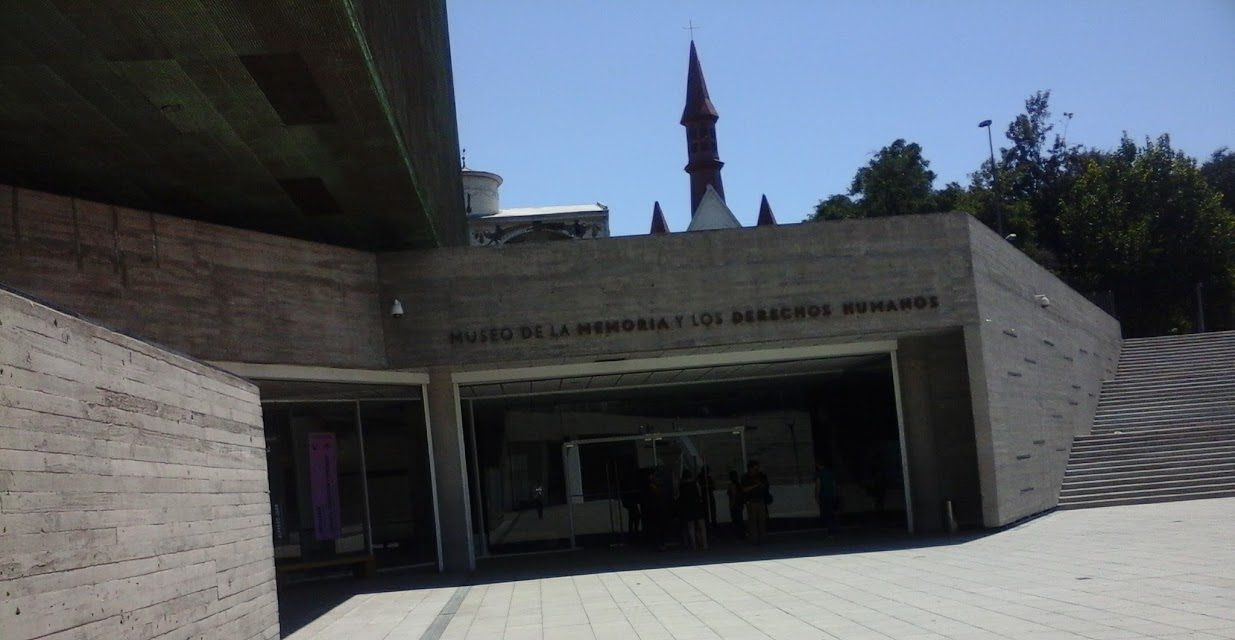
Museo de la Memoria y derechos humanos

museo de la memoria y los derechos humanos
The Museo de la Memoria y Derechos Humanos has created a project entitled Memorias del Exilio in order to give voice to the experiences of Chilean exiles. I am very moved and grateful to have had my story included in this archive. Recently I visited the museum. I went alone, as I wanted to get out-and-about by myself in the huge and beautiful city that is Santiago. It was a scorching day and I set off with a bottle of water in my wee leather bag, lots of enthusiasm and a general idea of its location. I got on the metro and for some reason I did not get a connecting train, maybe I saw a sign for Matucana and instead got off at Estación Central – the wrong stop. I asked a long-haired man who sold handcrafts on a street stall for directions. He seemed to be pleased I was going there and told me it was ‘quite a few’ cuadras (blocks) away and that I’d be better off taking a colectivo (communal taxi) on the other side of the road, otherwise the camino would entail a long straight walk of many blocks in the burning heat.Having recently arrived from a Scottish winter and craving sunshine, I decided to take the scenic route all the way up Matucana St. After all it was just a few blocks! So … seven or so blocks later (I lost count), and red as a tomato, I came across the museum! There it was! Right opposite the Quinta Normal Park. The building itself was a sight to behold! The vast space and impressive architecture gave you a sense of awe, commanding instant humility and respect. The first display I saw, as I headed for the main doors, was of an aircraft boarding stairs replica, with the words ‘ASILO. EXILIO’ printed in huge white letters on its side. I stared at it and felt a little twitch in my stomach, like a little punch, which made me exhale through my nose.
The display took me back to the day we left Chile all those years ago, when as a lanky kid I had had to climb the real stairs up to a plane for the first time. The sun shone brightly that day too, as I turned around on the top step and looked out toward the mirador of what was then Pudahuel International Airport*. My eyes scanned the airport terrace for a glimpse of my dad, my gran or friends but all I saw was the building and the glare of the sun. Perched on that final step, facing the airport, still and speechless, I heard my mother encouraging me to wave goodbye as she walked up the stairs towards me.
These snippets of memory triggered tears which came and went freely during the whole visit and which often blurred my vision when trying to read labels or articles once inside. It was impossible to hide the tears. I noticed I wasn’t the only one crying. The testimonies, vinyls of the New Song Movement, photographs, posters and films resonated intensely with me. I felt deeply affected yet strangely comforted. It was like hearing my parents talking to me…or like visiting my early childhood.
For the first time ever I was occupying this honorable space created to commemorate the victims of human rights abuses committed during the dictatorship years. In many ways I was witnessing my mum and dad’s history as well as the recent history of my people. The evidence was all there in a very tangible way. Immensely proud that my parents had always campaigned for Allende (every time) and that they had lived their lives according to their principles, I was overwhelmed by a strong sense of love for them, for all my compatriots and our President Allende. I left the museum with an unyielding feeling of love for my country, my people and comforted by the thought that I belong. That as the Illapu song Tres versos para una historia says, ‘soy parte de esta historia’, I am part of this story!
I said farewell with a strengthened belief that the creation of this museum is a fundamental part of a national process of healing, one we cannot do without. Memory must be preserved by all means and in all forms. There is a past – our parents – and a future – our children, and we must do this for them and for future generations.
*The area where the airport is situated is called Pudahuel. In Mapudungun, the language of the Mapuche, ‘Pudahuel’ means ‘place where waters merge’ or ‘in the lakes’. During the Pinochet years the airport’s name was changed to ‘Comodoro Arturo Merino Benítez International Airport’, after the founder of the Chilean Airforce and Chile’s airline, LAN.
Memory must be preserved by all means and in all forms. There is a past – our parents – and a future – our children, and we must do this for them and for future generations.
“The display took me back to the day we left Chile all those years ago, when as a lanky kid I had had to climb the real stairs up to a plane for the first time.”
museo de la memoria y los derechos humanos
The Museo de la Memoria y Derechos Humanos has created a project entitled Memorias del Exilio in order to give voice to the experiences of Chilean exiles. I am very moved and grateful to have had my story included in this archive. Recently I visited the museum. I went alone, as I wanted to get out-and-about by myself in the huge and beautiful city that is Santiago. It was a scorching day and I set off with a bottle of water in my wee leather bag, lots of enthusiasm and a general idea of its location. I got on the metro and for some reason I did not get a connecting train, maybe I saw a sign for Matucana and instead got off at Estación Central – the wrong stop. I asked a long-haired man who sold handcrafts on a street stall for directions. He seemed to be pleased I was going there and told me it was ‘quite a few’ cuadras (blocks) away and that I’d be better off taking a colectivo (communal taxi) on the other side of the road, otherwise the camino would entail a long straight walk of many blocks in the burning heat.Having recently arrived from a Scottish winter and craving sunshine, I decided to take the scenic route all the way up Matucana St. After all it was just a few blocks! So … seven or so blocks later (I lost count), and red as a tomato, I came across the museum! There it was! Right opposite the Quinta Normal Park. The building itself was a sight to behold! The vast space and impressive architecture gave you a sense of awe, commanding instant humility and respect. The first display I saw, as I headed for the main doors, was of an aircraft boarding stairs replica, with the words ‘ASILO. EXILIO’ printed in huge white letters on its side. I stared at it and felt a little twitch in my stomach, like a little punch, which made me exhale through my nose.
The display took me back to the day we left Chile all those years ago, when as a lanky kid I had had to climb the real stairs up to a plane for the first time. The sun shone brightly that day too, as I turned around on the top step and looked out toward the mirador of what was then Pudahuel International Airport*. My eyes scanned the airport terrace for a glimpse of my dad, my gran or friends but all I saw was the building and the glare of the sun. Perched on that final step, facing the airport, still and speechless, I heard my mother encouraging me to wave goodbye as she walked up the stairs towards me.
These snippets of memory triggered tears which came and went freely during the whole visit and which often blurred my vision when trying to read labels or articles once inside. It was impossible to hide the tears. I noticed I wasn’t the only one crying. The testimonies, vinyls of the New Song Movement, photographs, posters and films resonated intensely with me. I felt deeply affected yet strangely comforted. It was like hearing my parents talking to me…or like visiting my early childhood.
For the first time ever I was occupying this honorable space created to commemorate the victims of human rights abuses committed during the dictatorship years. In many ways I was witnessing my mum and dad’s history as well as the recent history of my people. The evidence was all there in a very tangible way. Immensely proud that my parents had always campaigned for Allende (every time) and that they had lived their lives according to their principles, I was overwhelmed by a strong sense of love for them, for all my compatriots and our President Allende. I left the museum with an unyielding feeling of love for my country, my people and comforted by the thought that I belong. That as the Illapu song Tres versos para una historia says, ‘soy parte de esta historia’, I am part of this story!
I said farewell with a strengthened belief that the creation of this museum is a fundamental part of a national process of healing, one we cannot do without. Memory must be preserved by all means and in all forms. There is a past – our parents – and a future – our children, and we must do this for them and for future generations.
*The area where the airport is situated is called Pudahuel. In Mapudungun, the language of the Mapuche, ‘Pudahuel’ means ‘place where waters merge’ or ‘in the lakes’. During the Pinochet years the airport’s name was changed to ‘Comodoro Arturo Merino Benítez International Airport’, after the founder of the Chilean Airforce and Chile’s airline, LAN.