Scotland celebrates Violeta Parra’s centenary. Escocia celebra el centenario de Violeta Parra
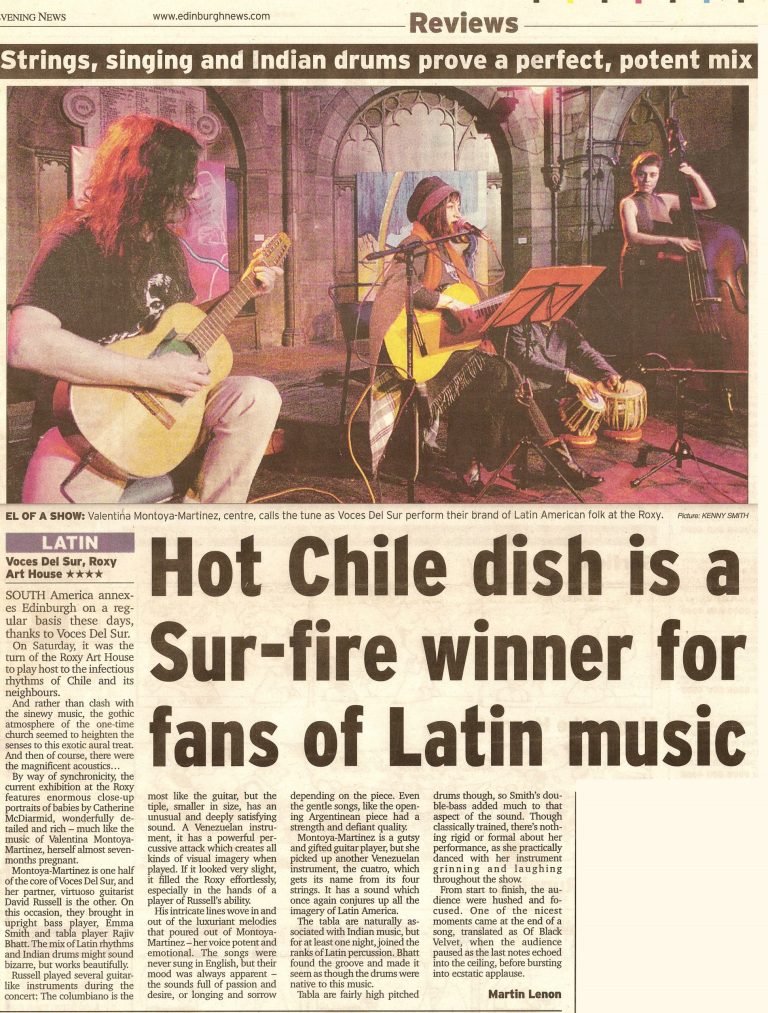
Valentina and Voces del Sur pay homage to renowned Chilean singer/songwriter and artist, Violeta Parra. 2017 sees 100 years since Parra’s birth and this is the first event to celebrate it in Scotland. The evening is presented by Valentina Montoya Martínez’s band Voces del Sur with special guests directly from Chile, the much loved Chilean group ‘Los Hermanos Millar‘. The programme includes many of Violeta Parra’s own songs as well as songs that she collected during her many voyages throughout Chile (which she made in order to preserve the country’s cultural heritage, against a backdrop of a systematic attempt to erode local culture). There will be readings from her memoirs.
Here is a note from Valentina about the impact of Violeta Parra in her own life:
Violeta Parra has been a fundamental cultural figure in my life. I want to thank her on the centenary of her birth by paying homage to her outstanding life’s work. We are singing for Violeta Parra! For more details go to Celebrating Violeta Parra’s birth centenary.
I have grown up listening to Violeta Parra. Her music was not something I ‘discovered’ or stumbled upon. Violeta, like my mother, was always there, from my earliest memories. Her music, alongside that of Víctor Jara and many other Chilean artists from the Chilean New Song Movement, was part of my household. I lived and breathed it. It formed a beautiful part of our lives, which I like to synthesize into a singular image, that of Víctor Jara’s smile. Then came the dictatorship, my father’s imprisonment, our exile. Violeta’s music came with us, as did the music of the New Song Movement. Bereft of our homeland, music became our life source as did the cultural evenings, marches, meetings, handcraft making, jumble sales, hunger strikes and singing. As I reached adolescence in a foreign country Violeta Parra became my umbilical chord to my land of birth. Initially songs like ‘Gracias a la Vida‘ often had me in tears – too heavy a weight of melancholy on my young shoulders. But the older I got the better I was able to raise above the sadness and truly listen to it. The more I engaged with it the fresher it became and the more it healed my soul. Who could fail to be moved by ‘Run Run se fue pa’l norte‘, to put oneself in Violeta’s shoes, to link it to our own realities? And have we not all felt, at one point or another, like cursing and sending it all to hell like she does in ‘Maldigo del alto cielo’? Yes, Violeta cursed but she also gave light, gave insight, gave strength. Letters were always important to us, particularly in the early days of exile. I remember one winter evening, whilst we carved little wood figurines in our council house in England, the song ‘Me mandaron una carta’ began rolling from a tiny cassette. We had recently read a letter with the news that a relative had been ambushed by the Chilean secret police and killed in a shower of bullets. The song, in this new context, shook me to the soul. I didn’t cry. The waves roared internally, gnawing up and down my chest whilst Violeta’s voice expressed what I was too young to say. (Extract from my work-in-progress book ‘Café Cero’).
En español:
Crecí escuchando a Violeta Parra. Su música no era algo que ‘descubrí’ o algo con lo cual me topé. Violeta, como mi madre, siempre estuvo ahí, desde mis primeros recuerdos. Su música, junto a la de Víctor Jara y muchos otros artistas chilenos, formaban parte de mi hogar. La viví y la respiré. Formó una parte hermosa de nuestras vidas, cosa que me gusta sintetizar en una imágen singular, la sonrisa de Víctor Jara. Luego vino la dictadura, el encarcelamiento de mi padre, nuestro exilio. La música de Violeta vino con nosotros, al igual que la música del la Nueva Canción chilena entre otras. Despojados de nuestra patria, su música se convirtió en nuestra fuente de vida, al igual que las tardes culturales, marchas, reuniones, trabajo artesanal, mercados de pulgas, huelgas de hambre y el canto. Al llegar a la adolecencia en una tierra extranjera, Violeta Parra se convirtió en el cordón umbilical que me conectaba a mi país natal. Canciones como ‘Gracias a la vida‘ a menudo me llenaban de lágrimas, un peso de melancolía extraordinario para mis frágiles hombros. Pero en cuanto más crecía mejor era mi habilidad de alzarme más allá de la tristeza y mayor era mi capacidad de escuchar verdaderamente su canto. Mientras más me sumergía en esa ternura infínita más fuerte sanaba mi alma. ¿Quién podría dejar de ser conmovida por ‘Run Run se fue pa’l norte’, de ponerse en sus zapatos, de atar el tema a nuestras propias vidas? ¿Y acaso no hemos sentido todos en algún momento ganas de maldecir todo, de mandar todo a la mierda como en la canción ‘Maldigo del alto cielo‘? Sí, Violeta maldecía, pero también daba luz, daba visión, daba fuerza.
Las cartas siempre fueron importantes para nosotros, especialmente en las primeras etapas del exilio. Recuerdo una noche invernal en Inglaterra, mientras tallábamos pequeñas figuras de madera en nuestra casa council, la canción ‘Me mandaron una carta‘ empezó a rodar desde un minúsculo cassette. Habíamos leído recientemente una carta con la noticia de que un pariente había sido emboscado por la CNI y había muerto en una lluvia de balas. La canción, en este nuevo contexto, me sacudió hasta el alma. No lloré. Las olas rugían internamente, carcomiendo mi pecho de arriba a abajo mientras la voz de Violeta expresaba lo que yo era demasiado joven para decir”. (Extracto de trabajo en proceso, mi libro – Café Cero)